
A SMALL WINDOW. A MUCH BIGGER WORLD.
Beyond
Chatbots
Raising the ceiling on our
mental models about AI.
01 The room we started in
It began with a blinking cursor.
For many of us, the first encounter was a chatbot: ChatGPT, Gemini, or Copilot. A text box. A question. An answer.
Most educators’ first interaction with GenAI was ChatGPT, sometime in late 2022 or early 2023. They opened it up, saw a clean interface that looked a lot like Google, typed in a question or asked it to write something, and got a response.
From that moment, their mental model of what AI is was set.
IYKYK: How Do We Know What AI Can Really Do? ↗If your first experience was asking ChatGPT to summarise a document, then AI is a summarising tool. If you used Microsoft Copilot as a replacement for Bing, then AI is a search engine. If a colleague showed you how to generate a quiz, then AI is a quiz generator.
That first interaction becomes a ceiling. You file the technology under a category, and stop exploring.
IYKYK: How Do We Know What AI Can Really Do? ↗And the familiar interface can be misleading. An answer that sounds confident can still be completely invented. A language model generating an answer is not the same thing as a search engine finding a source.
But the more interesting problem is everything that this little box doesn’t show you.
The interface is not the capability.
02 Make a little more room
The chatbot is only the doorway.
A typical AI chatbot app has a text box and a blinking cursor. The interface gives you very few signals about what the system can do.
You don’t spontaneously think to ask a “writing tool” to build you a web application, convert a file format, analyse a dataset, or connect multiple software systems together.
Traditional software handles discoverability through menus, buttons, tooltips, and visual cues. Microsoft Word has a ribbon full of features. Photoshop has toolbars. These are signals that tell you what’s possible.
IYKYK: How Do We Know What AI Can Really Do? ↗Everything that happens on a computer happens in code and through software. GenAI is proficient at writing and manipulating code. Therefore, it follows that many operations a computer can carry out can be carried out by GenAI.Practical AI Strategies 2 ↗
The LLMs sitting just underneath the chatbots are capable of “speaking code” fluently enough to turn them into digital Swiss Army Knives.
The model needs the right environment and access to tools to act. Give it those, and the conversation can become a way of getting things done.
Controlling Hardware with Generative Artificial Intelligence ↗AI can be an interface to computing.
03 Your first discovery
A file is not a sealed box.
Once someone shows you that AI can edit the XML inside a PowerPoint file, your mental model cracks open a little.
I don’t like how PowerPoint slides look. I do like how HTML slide decks look, with their clean typography and modern layouts. But I also like PowerPoint’s functionality: presenter notes, easy sharing, compatibility with school systems. So I learned to do both.
I use AI to build slides in PowerPoint for structure and content, then upgrade them visually by rendering them as HTML, and then screenshot those HTML slides back onto blank PowerPoint slides.
Did You Know AI Can Do… That? ↗File formats aren’t endpoints. They’re waypoints.Did You Know AI Can Do… That? ↗
You can move between them strategically, using each format for what it does best.
Now extend the idea. If a presentation is structured data that software can read and change, what else could be opened up, transformed and rebuilt? A report? A spreadsheet? A whole folder of resources?
You start asking different questions. You stop thinking about what AI is and start thinking about what it could do.
Did You Know AI Can Do… That? ↗Look for the structure beneath the surface.
04 From knowing to doing
Don’t just ask for an answer. Make a tool.
You no longer have to find niche software that does what you want: you can describe the thing you need and have AI build it to your specification.
When I asked readers to share their unusual uses of AI, educators were having it build working tools on demand rather than just write text.
Someone generated a drag-and-drop quadrant activity that aggregates a whole class’s responses and flags where they disagree; someone else built a maths tool that walks a student through the order of operations; another made a space-themed game for practising ratios.
IYKYK Part 6: Practice to Principles ↗Interactive simulations can be generated, then refined, and dropped straight into a learning management system as standalone HTML.
More than one person described setting out to build something, only to have AI surface an existing open-source tool that already did the job better than they could have managed.
IYKYK Part 6: Practice to Principles ↗AI is not necessarily the answer to the problem: it might point the way to “traditional” software, or build a tool which replaces itself in the process.IYKYK Part 6: Practice to Principles ↗
This little ratio tool works without a language model running behind it. The code does the calculation. Change it, check it, try it again. That distinction is useful far beyond a classroom.
AI can make tools that work without AI.
05 Give the tools a loop
Act. Check. Adjust. Repeat.
An AI agent is a large language model-based application that semi-autonomously uses other tools and applications to complete multiple tasks.
The key thing is that AI agents, like the rest of GenAI, are not magic. They are code. We give a large language model access to a real or virtual computer environment and let it use tools.
These agents can draw on all sorts of tools: writing and running Python scripts, unpacking PowerPoints to expose the raw code and rebuilding them from the ground up, opening applications, taking screenshots, viewing their own work for quality assurance, and making edits.
A Taxonomy of Agentic AI ↗They iterate through a task until either the AI or you are satisfied with the results.
“AI agent” means different things depending on who you ask. My taxonomy separates five kinds: code-using chatbots, browser-based agents, computer-use agents, command-line agents, and agent teams or swarms.
A Taxonomy of Agentic AI ↗Think of these as expanding working environments. The boundaries overlap, and a higher number isn’t a guarantee of better results. The useful question is what tools the system can reach, and how it uses feedback.
A simplified reading of Leon’s March 2026 taxonomy.
An agent uses tools in a feedback loop.
06 Beyond the chat window
The whole computer becomes the workspace.
We now have a technology proficient in the languages of both humans and computers.
AI can browse the web. Not just search it, but actually navigate websites, click buttons, fill in forms, and extract information from pages.
AI can connect to your actual tools. Through protocols like MCP (Model Context Protocol), AI can read and write to your email, your calendar, your databases, your project management tools. Not through copy-paste, but through direct integration.
Did You Know AI Can Do… That? ↗Computer use brings together coding capabilities and multimodal image recognition: reading screenshots to “see” the computer in the way a human user might.
Recently, I used AI to edit two screen recordings into one video: synchronising the actions, arranging the layout, adding transitions and blurring sensitive information. It used both command-line tools and desktop editing software.
Computer Using AI is Solved ↗Almost any individual task that happens in a digital environment can now be completed by a sufficiently capable LLM.Computer Using AI is Solved ↗
That is the argument behind “Computer Using AI is Solved”. It doesn’t mean every attempt works, every system has the same capabilities, or entire jobs disappear. It means the practical boundary has moved.
Text, images, audio and video become inputs and outputs in a larger workflow. The chatbot is one window into it.
A conversation can become action across software.
07 A door to the outside
And code doesn’t stop at the screen.
Physical devices also run code. Millions of devices in our day-to-day work and personal lives run on code.
On our off-grid farm, I used AI to build a dashboard around the solar system and a notoriously inaccurate diesel fuel gauge. The real dashboard is read-only; I tested control in a simulator.
It’s a small example of a much bigger idea: language models acting as an interface between software and hardware.
Controlling Hardware with Generative Artificial Intelligence ↗Anthropic’s proposed Model Hardware Standard (MHS) explores a common interface for devices. Its research preview includes AI coordinating robotic arms, liquid handlers and laboratory instruments.
Those are early, supervised experiments, not universal plug-and-play hardware. But the direction is striking: describe an intention in human language, translate it into device operations, and read the result back.
Anthropic: Model Hardware Standard research preview ↗The future of AI has very little to do with chatbots.Controlling Hardware with Generative Artificial Intelligence ↗
Software is a bridge to the physical world.
08 A different question
Once you know, you know.
Once you discover one capability that breaks your existing mental model, you start asking different questions about everything else, and lift the ceiling a little.
Transferability is what happens when the experience of successfully completing one task changes how you think about every other task.
When a teacher discovers that AI can analyse a dataset of student results and identify patterns, they don’t just gain a new app for data analysis. They gain a new question: what else in my work involves patterns that I’m currently identifying manually?
IYKYK Part 4: From Knowing to Doing ↗The capability transfers because the teacher’s mental model has shifted. But the technology amplifies expertise; it doesn’t replace it.
And discovery is also an access problem. You can’t discover what you can’t afford. Time, licences, confidence and institutional restrictions all shape who gets to experiment.
IYKYK Part 3: Who Gets to Know? ↗We shouldn’t let our own limited first impressions define the boundaries of what’s possible.IYKYK: How Do We Know What AI Can Really Do? ↗
This page is one example: your author’s writing, a description of a world, and AI using code and tools to help make a working experience. It is also an invitation.
Take one capability you’ve discovered here. Apply it somewhere familiar. Bring your expertise, check the result, and ask a better question.
What else could this help me do?
THE WORLD WAS ALWAYS BIGGER THAN THE WINDOW.
What else
could this thing do?
You don’t need to know every possibility.
You need a reason to ask a different question.
THE NEXT CHAPTER
Interested in learning more about the future of AI in education?
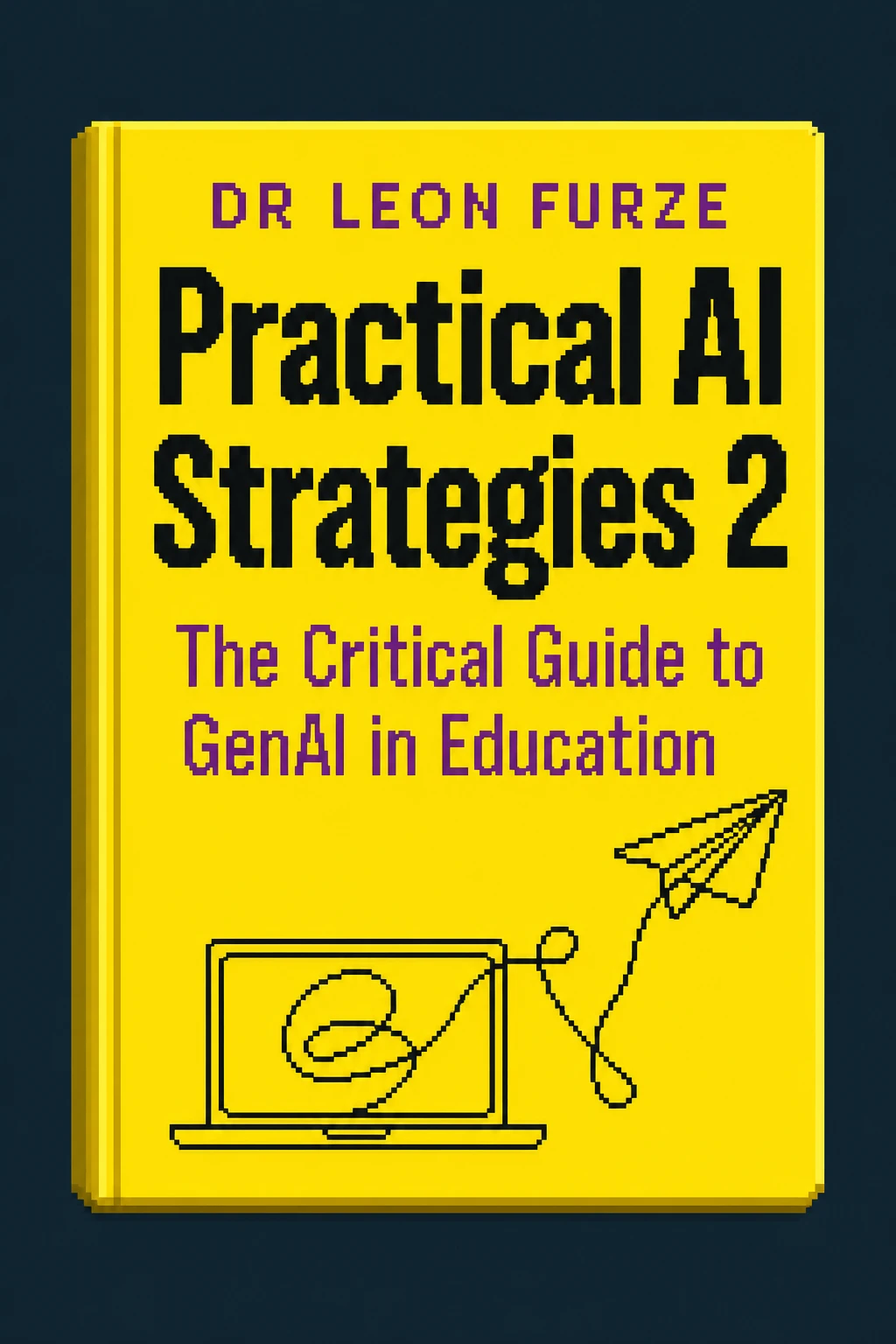
Practical AI
Strategies 2
Out Now
Available from Amba Press and all major online bookstores.
Get the book at Amba Press ↗